
Retrofitting soft-close & dampers for sliding doors
No more slamming sliding doors and trapped fingers. Soft close calms everyday life and protects the material. Retrofitting is often quick and easy - and it feels better from the very first pull.
Advantages of Soft-Close
The door brakes gently and closes in a controlled manner. This protects fingers, edges and nerves. At the same time, the noise level is significantly reduced. Your sliding door system lasts longer and feels more valuable - a small upgrade with a big impact.

Compatibility & requirements
Door material (wood/glass), door weight & width
Check the material, width and weight of the door. The damper set must be able to withstand these values. Read the specifications on the system and compare them.
Recognize track/system type
Inspect the rail, carriage and stopper. Make a note of the manufacturer and profile shape and take photos. Many systems can be retrofitted with suitable kits. The more precise your information, the easier the selection will be. This saves time.
One/two-sided damping (opening/closing)
Consider whether the door should only brake when closing or also stop gently when opening. Check the space in the track and the position of the stoppers. Soft closing on both sides noticeably increases comfort. However, one side is often sufficient in small rooms.
Choosing the right damper set
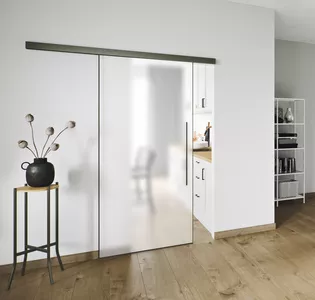
Retrofit kits for common rail types
Many running rails for sliding doors can be retrofitted without the need for a complete replacement. Pay attention to the manufacturer's parts drawings and approvals. A compatible set reduces effort and risk.
Load ranges & castor compatibility
Compare the load capacity of the dampers with the door weight. Check whether the runner and hook fit together. If the interfaces are correct, the set fits perfectly. Test the movement before final installation. You will immediately feel whether everything harmonizes.
Secure & unhinge sliding door (if necessary)
Secure the panel against tilting and work in pairs. Only unhinge the sliding door if the installation requires it. Prepare soft underlays to protect the edges.
Accessories: end caps, guides, stoppers
Replace worn end caps and check the floor guide. A cleanly guided blade runs more smoothly and makes better use of the damper. Set the stoppers correctly and pre-mark the position.
Retrofitting soft-close: step-by-step installation

Installing catch hooks on the door leaf (wood vs. glass)
For timber, screw the hook on directly, with pre-drilled holes and depth stop. For sliding glass doors, only use approved clamping solutions or adapters. Never drill holes in glass afterwards. Tighten screws moderately and check the fit.
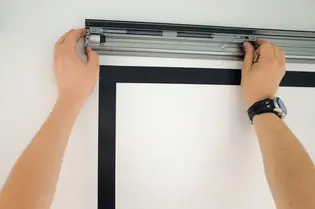
Positioning & fixing the damper unit
Mark the position according to the instructions and align the unit exactly. Screw it tight without tilting. Pay attention to the installation direction and height so that the hook runs in cleanly later. A dry test helps. The unit will then fit on the first attempt.

Fine adjustment & function test
Hook the blade and move it slowly in both directions. The hook should grip softly and pull the door in in a controlled manner. Adjust the position millimeter by millimeter until the barrel works perfectly. Test several times at real speed. This is how everyday use feels right.
Fine tuning, maintenance & troubleshooting
Set retraction force/end position
Adjust the spring force until the door closes softly but firmly. Set the end position so that the handle does not strike. Check the setting again after a few days. Temperature and use can change the behavior slightly. A quick turn will bring everything back on track.
Frequent assembly errors (rail inclination, distortion)
If the door runs by itself, the track is often hanging at an angle. Align it with the spirit level and check the distance from the wall. Ensure that the floor guide is free of play. Small corrections are usually sufficient. The door will then run as if on rails - in the best sense of the word.
Upgrade ideas & bundles

Quiet guide, floor guide, grip shell/strip
A high-quality floor guide minimizes play and noise. Handle shells fit perfectly with pocket doors, handle strips make a statement when installed in front of a wall. Match handles to door weight and handling. So every pull of the handle feels good. Design and technology go hand in hand.
Acoustic package: seal + soft close
Combine sealing profiles and soft-close for maximum convenience. The door glides quietly and voices penetrate less. Plan the seals at the same time so that you don't have to glue anything afterwards. The result looks like a single piece. And your home will sound more relaxed.
FAQ on soft-close topics
Yes, the rail, Running gear and space are often decisive. Check the manufacturer's approvals and the Load-bearing capacity. Photos of the system help with the selection.
Yes for best comfort, for tight situations one side is often enough. Decide according to use and space in the rail. Test the drain dry in advance.
Screwdriver, tape measure, Allen key ("Inbus") and, depending on the system, a drill for the rail. For Glass, only use adapters, never drill bits.