

Glass doors and all-glass doors for bright rooms
Glass doors bring natural light into hallways, living rooms, kitchens, bathrooms, and home offices. At GRIFFWERK, you’ll find all-glass doors made of tempered safety glass (ESG) and laminated glass (VSG)—available as classic hinged glass doors or space-saving glass sliding doors. Choose from clear glass, satin frosted glass, textured glass, and custom designs. Matching door handles and fittings complete the door system.
Advantages of Glass Doors
Glass doors connect rooms without completely blocking the view between them:
- More natural light: Clear and translucent glass surfaces bring light into adjacent rooms.
- Open-concept feel: Transparent doors make floor plans appear more spacious and brighter.
- Privacy when needed: Satin frosted, structured, or opaque glass protects privacy.
- Many design options: Glass colors, finishes, laser engravings, and printing techniques allow for custom designs.
- Easy to clean: Smooth glass surfaces are low-maintenance and resistant to moisture.
- Flexible door systems: Many designs are available as glass swing doors or glass sliding doors.
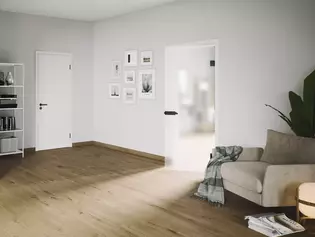
Which Glass door is right for your home?
- Glass swing door: Suitable when a traditional door opening and sufficient clearance for swinging are available. If the dimensions and fittings are compatible, an existing door frame can often be reused.
- Glass sliding door: Suitable when the door leaf is not supposed to swing into the room. In addition to the opening, there must be sufficient free wall space for the door leaf to slide into.
- Clear glass: A good choice when you want as much light as possible and an unobstructed view.
- Satin frosted or structured glass: Suitable when natural light should be preserved, but less direct visibility is desired.
- Opacity laminated glass: A solution for rooms with particularly high privacy requirements.
Which glass door variants are available - toughened safety glass or laminated safety glass?
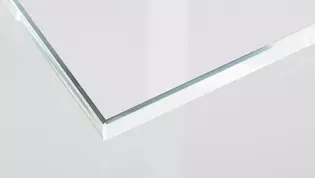
Tempered safety glass
Tempered safety glass is thermally tempered and offers increased impact and shock resistance. If broken, it shatters into many small, mostly blunt-edged fragments. The glass cannot be machined after tempering, which is why drill holes and dimensions must be determined before the tempering process begins.
- High safety
- High impact and shock resistance
- Blunt-edged shards in case of glass breakage
- Flexible design options
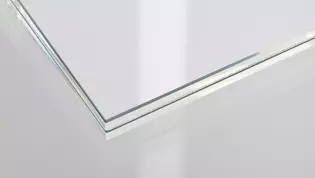
Laminated glass (VSG)
At GRIFFWERK, laminated glass consists of two safety panes bonded together with an inner interlayer. If the glass breaks, the fragments remain adhered to the interlayer. Depending on the design, the laminated glass offers additional features such as enhanced privacy or improved sound insulation. The actual sound insulation depends on the entire door system—including the door frame, seals, bottom seal, and installation conditions.
- High safety
- More sound insulation
- Ideal for XL formats
- Matting possible on both sides
- Highest opacity possible
- Rich sound when closing
Modern and individual Glass doors from Griffwerk
Glass doors are not only functional, but also an aesthetic highlight in any home. They allow light to flow and create an open, friendly atmosphere in your rooms. Whether as a room divider or a discreet design element - a glass door adds lightness and elegance to your living space. Our glass doors are available in numerous designs and surfaces, so you can find the perfect combination for your individual interior design style. Discover the variety of modern glass doors at Griffwerk, which can be harmoniously integrated into any living style.
Whether DIN right or left, laser-decorated or matt, hinged or sliding doors: at Griffwerk you are guaranteed to find the right model for your home. From hygge to ethnic style: we offer the right model and perfectly coordinated fittings for every style of living.
ESG glass doors


VSG glass doors


Download glass door catalog
Our enthusiasm for Glass was sparked in 2014 when we designed our first collection of Glass doors. Glass is a fascinating material because it is made exclusively from Nature or Nature-identical inorganic raw materials. Glass is a sustainable material that is 100 % recyclable. We process this high-quality material using finishing and printing processes. In 2016, we began researching the possibilities of laser technology and incorporating it into our production. We can produce and develop laser doors ourselves at our headquarters in Blaustein in southern Germany. Here is our catalog:
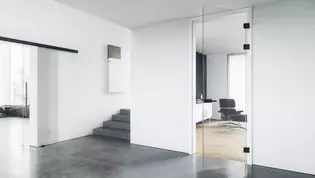
Glass doors: homely inspiration
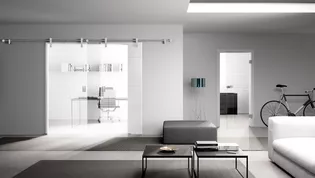
Glass doors make excellent room doors - whether for the kitchen, living room, hallway or bathroom. Replacing an existing door with a Glass door is very easy. For a glass revolving door, you can even use the existing frame. With Sliding doors made of glass, you can restage transitions between rooms. This looks good and saves space. None of the revolving glass doors or folding doors need to be pivoted. They run along the wall to save space. With the so-called Soft and self-closing mechanism, you treat yourself to additional convenience.
Every model from the GRIFFWERK range is basically available as a glass revolving door or as a Sliding door system.
Even in smaller apartments, previously unused side rooms can be transformed into attractive workrooms with the help of these models.
What is the tape side and the tape opposite side?
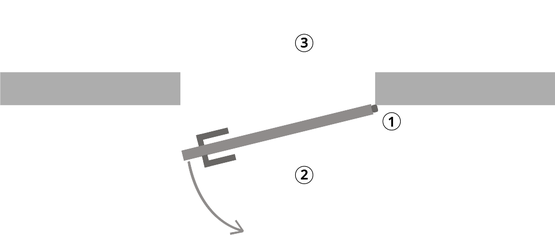
Door hinges connect a door to the door frame and at the same time allow it to rotate. The hinge side (2) is the side on which the door hinges (1) are located. The opposite hinge side (3) refers to the side opposite the door hinges.
What is the DIN direction for glass doors?
The DIN direction indicates in which direction a door opens. Do you want to find out which DIN direction is the right one for you? Then imagine you are standing in front of the door. It opens towards you. The side on which the hinges of the Hinged door are located - also called the hinge side - determines the DIN direction.

If the hinges are on the right, it is a DIN right-hand door.

If the hinges are on the left, your door is a DIN left door.
Glass door finishing techniques: technology and advantages at a glance
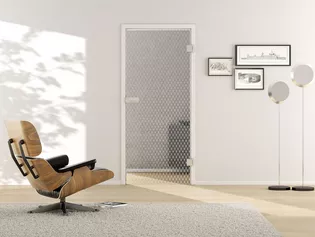
Glass door with digital printing
In the digital printing process, a motif is printed on the interior security film of an all-glass door made of laminated safety glass.
With transparent films, the design can be seen from both sides - mirror-inverted on the back of the Glass door. However, the film can also be matt or white, for example, which makes printed photos and motifs stand out clearly.
Advantages digital printing
- None fading of the Color thanks to protection from NL radiation by bonding of film and glass panes
- High resolution
- Radiant and high light fastness of colors behind the glass
- Transparency and translucency (light transmission)
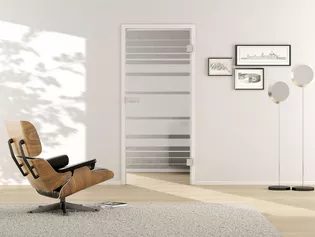
Glass doors with screen printing
For screen printing on the glass door, ceramic paint is permanently baked into the glass during the manufacturing process of the toughened safety glass.
The screen printing process additionally seals the glass surface with the application of motifs. The finished glass door has a closed, smooth surface that is extra scratch-resistant.
Advantages screen printing
- Very high scratch resistance
- Abrasion and weather resistant
- Hard-wearing
- Easy to clean
- Precise printing of motifs
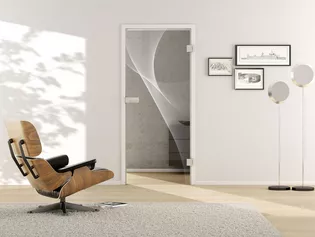
Glass door with laser technology
For finishing with laser technology, laser beams are bundled and focused with millimeter precision. The laser penetrates 0.3 mm deep into the surface of the glass. The spot where the laser hits is melted for a short time. Safety glass is not negatively affected. Precisely controlled laser beams create images on the glass using a series of dots.
Advantages laser technology
- Stunning clarity and sharpness
- High luminosity and beautiful lighting effect
- Noble and stylish
- Individual ideas can be easily realized
Glass doors and the fascination of laser technology
Special lasers engrave filigree Lines into the glass surface. Point by point and precisely controllable, detailed images, patterns and lettering as well as finely graduated gradients can be transferred to the Glass. Our laser places microscopically small pixels next to each other for this purpose, so that photorealistic results can be achieved. The recessed engravings change the reflection of light. Lasered Glass doors remain transparent. The TWO SIDES option with satin finish on the back provides more privacy.

Laser-engraved glass doors from Griffwerk meet ESG standard
GRIFFWERK offers tested safety for lasered glass doors made of single-pane safety glass ("TSG glass"). According to the German Institute for Building Technology (DIBT), the laser technology applied by GRIFFWERK fulfils all requirements. Since then GRIFFWERK is allowed to mark all glass doors with the TSG test stamp.
The stamp contains the number of the standard (DIN EN 12150) and is placed on the edge of the glass on the hinge side. ESG is available from GRIFFWERK as green glass or elegant white glass PURE WHITE by GRIFFWERK. Both types of glass also meet the ESG standard when lasered.
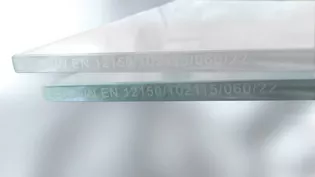
Thanks to laser decor: glass doors to suit your individual taste
We realize your ideas
Have your favorite quote, your children's names or any text lasered onto your Glass door! Choose the size, format and placement according to your ideas.
If you are interested, please ask your
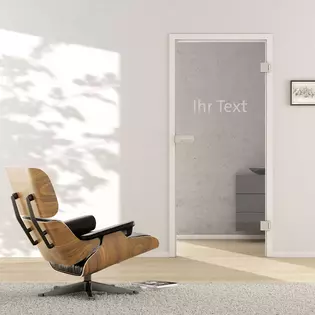
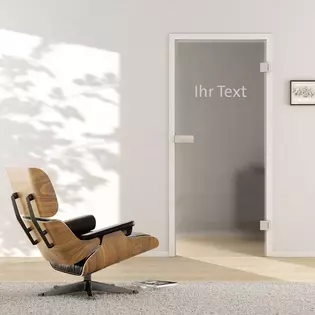
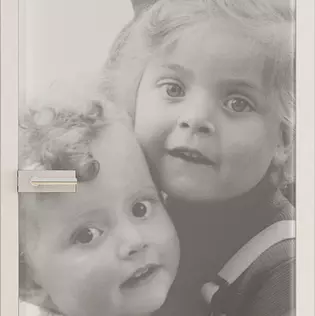
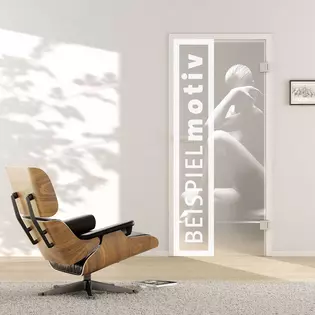
Your favorite picture as a laser engraving?
Whether a family photo or memories of an unforgettable moment - create your own design.
Talk to your specialist dealer!
Two sides of a Glass door - Two Sides
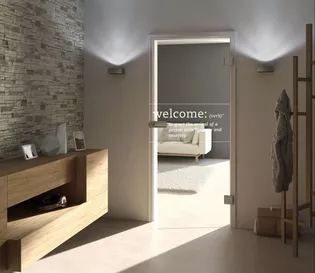
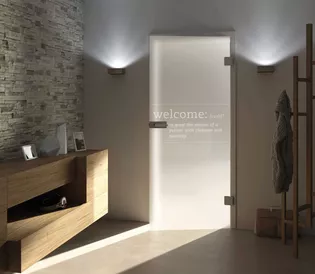
Our extensive range is also available in the transparent "TWO SIDES" variant, which is processed on both sides: one side is lasered, the other is flat Satin frosted. This allows you to choose from a variety of favorite designs for your all-glass door while getting more privacy with the frosted glass.
By the way, our TWO SIDES option has nothing to do with the difference in DIN Direction - that is, whether you are dealing with "DIN Left" or "DIN Right" doors. If hinges and hinges are mounted on the left, they are "DIN-left" doors. If they are mounted on the right, they are "DIN right" doors.
What is Laser One Side?
- ONE SIDE means one-sided processing of the all-glass door with laser technology.
- Here a clear glass blank is used
- The transparency of the door is maintained
- Depending on the incidence of light, the lasered area scores with its high luminosity
- One Side is very noble and stylish
What is Laser TWO SIDE?
- With TWO SIDE, the manufacturer processes the all-glass door on both sides
- The glass door blank has a full-surface silk-screen print on the back side (matted on the back side)
- The laser decor is on the front side
- The translucency is in the foreground here
- Brighter rooms despite guaranteed privacy
Glass doors with style: a harmonious look for the entire home.
If you opt for high-quality glass doors, you don't want to compromise on the details. With our diverse range, you have the opportunity to perfectly coordinate your living space. Choose your preferred color for door handles - from elegant cashmere grey to stylish stainless steel and a luxurious brass look - and let your glass doors blend harmoniously into the overall look of your home.
Why glass doors:
- More daylight: Bright, friendly rooms - even in hallways and hallways.
- Greater sense of space: transparency opens up floor plans without conversion work
- Privacy of your choice: clear glass, satin finish or gray tones
- Quieter living: Can be planned to reduce noise in matching systems
- Easy-care & durable: ESG/VSG quality - robust for everyday use
How do I clean glass doors?
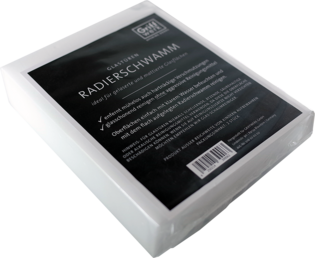
Clean the glass surface with warm water and a soft, lint-free cloth. For fingerprints, you can use a suitable glass cleaner. Avoid using abrasive materials as well as highly acidic, alkaline, or corrosive cleaning agents, as these can damage glass finishes and adjacent components. Also, follow the care instructions for the specific glass door model.
For laminated glass doors, ensure that the edge seal does not come into contact with water, as moisture and the cleaning agent could otherwise penetrate the laminate.
For satinized and lasered surfaces
To avoid abrasion, you should not apply too much pressure here. To prevent so-called cloud formation, rub your glass door dry over a large area with a microfiber cloth. Do not use paper or cellulose cloths. They cause too much abrasion.
For screen-printed glass
Screen-printed models are softer than pure glass and therefore more sensitive to mechanical cleaning agents. In addition, they must not come into contact with acids, as these can attack the printed image.
Attention
Please do not use any scratching tools, razor blades or scrapers. They can leave visible and irreparable scratch marks.
Glass doors: suitable for any interior
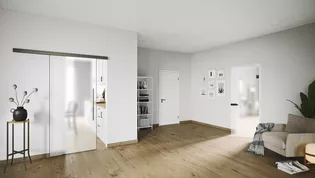
From iconic Bauhaus to casual boho style, the all-glass door reveals a wide range of styles. Modern living is characterized by clean lines and minimalist flair, while boho style is highlighted by etched glass with playful patterns and earthy tones. Scandinavian living aesthetics are reflected by bright transparency and simple frames, while the country house style focuses on rustic elegance with subtle embellishments. Followers of the hygge concept are attracted to warm, cozy glass, while the art deco style shines with elegant patterns and sophisticated glass gloss. Glass doors convey style diversity in a unique way, be it minimalism or opulence.
Hinged door or sliding door?
- Hinged door: classic look, quick installation, wide variety of glass.
- Sliding door: saves swing area, zoned open - optionally tight-closing (e.g. PLANEO AIR SILENT). griffwerk.de
- Tip: Small rooms usually benefit from sliding solutions; for bathrooms en suite often satinized glass.
Inspiration: Why glass doors?
- Hallway & hallway: Clear glass brings light into the stairwell - optionally with discreet line designs.
- Home office: Satin-finished glass reduces distractions, clear doors make rooms appear open.
- Bathroom en suite: textured or frosted glass protects privacy with a bright overall appearance.
Tip: Choose matching fittings!
- Hinges & lock cases: Fittings optimized for glass ensure smooth running and a clean gap pattern.
- Lever handles: Matt surfaces (e.g. velvet gray/graphite) look harmonious with satin or gray glass.
- Compatibility: Pay attention to the glass thickness (ESG/VSG) - systems are designed for 8/10 mm (see product details).
Glass doors for Different Rooms
- Glass door for the hallway: Clear glass or partially satin frosted glass can allow daylight from living spaces to reach darker hallways and entryways.
- Glass door for the bathroom: Satin frosted, structured, or opaque glass prevents people from seeing directly inside. You should also check whether a lock and an emergency release are needed.
- Glass door for the kitchen: A glass swing door separates the kitchen from the living area Without completely blocking the light. A tightly sealing door system is important for minimizing odors and noise as much as possible.
- Glass door for the home office: Partially satin-finished glass combines natural light with privacy. If greater sound insulation is required, the door frame, seals, and bottom seal should be designed accordingly.
- Glass door for the living and dining room: Clear or tinted glass surfaces maintain visual connections and allow for a flexible link between living areas.
Which glass door provides privacy?
Privacy depends on the type of glass, surface finish, lighting, and viewing distance.
- Clear glass: maximum transparency, none of the privacy
- Partially Satin frosted glass: privacy in selected areas
- Fully Satin frosted glass: high privacy while maintaining good light transmission
- Textured glass: distorts contours and reduces direct visibility
- Opacity laminated glass: very high privacy due to internal films
- Gray glass: reduces transparency but is not automatically opaque
For bathrooms and bedrooms, the effect should also be checked with the room lights on.
Why a glass door?
- Ensuring natural daylight in every living space—through both hinged and sliding doors
- A more spacious feel and a loft-like living experience thanks to transparent transitions
- Privacy provided by opacity still allows light into the room
- Certified safety with single-pane or laminated safety glass (Tempered safety glass / Laminated glass)
- Plenty of design flexibility thanks to custom motifs
- Durable, as it is less susceptible to scratches and wear. Smooth glass surfaces are easy to maintain and show minimal wear when cleaned properly.
- Glass door leaf: Material that is without off-gassing, promoting a healthier living environment
- Sound-insulating properties contribute to peace and privacy
- Elegant aesthetics and a timeless appearance complement a variety of interior design styles
- Barrier-free access without a door threshold allows for easy movement throughout the home: Sliding door systems without a continuous floor track can support a low-threshold interior design.
- Glass is a sustainable material that is recyclable and has environmentally friendly properties. Glass can generally be recycled as a raw material. The available recycling options depend on the type of glass, its coating, and other components.
- The wide variety adapts to your personal preferences and design styles
- Depending on the model, sound-insulating properties help reduce noise
- They create a connection between indoor and outdoor spaces and expand the living area
- Visual continuity creates a harmonious sense of space
- Transparency promotes interaction and communication within an apartment or on a floor
- Sliding doors made from glass allow small rooms to be divided into different living areas
Glass door: FAQ
A whisper latch is a door latch that has been partially coated with plastic. The plastic dampens the impact of the metal latch in the lock. Doors can thus be closed "whisper quietly". Whisper latches are available for door handles for wooden doors as well as for glass lock cases on all-glass doors.
You can even find reasonably priced glass doors from Griffwerk for less than 150 euros. Our most luxurious models are priced at more than 1000 euros.
If you’re looking for sound insulation, glass doors are a great option. Our all-glass swing doors meet only Sound Insulation Class 1 (SK1 according to DIN 4109). Actual sound insulation always depends on the overall system—particularly the installation situation, frame, and seals. Glass tends to reflect sound rather than allow it to pass through. At the same time, it has none of the cavities and is relatively inert to vibrations, which generally has a positive effect on sound insulation performance. Tip: Standard laminated glass (VSG) offers none of the significant acoustic advantages of tempered safety glass (ESG) of the same thickness. Improved sound insulation values are only possible with special soundproof laminated glass (VSG) constructions. A special feature of glass doors: They require a floor gap to prevent damage from dirt particles. This can be partially compensated for by sound-absorbing materials in the room—such as carpets or curtains.
Yes. Existing frames for wooden doors can also be used for glass doors. When installing a glass door, please note whether 2-part hinges or 3-part hinges are to be used. To match the respective hinges, only the frame section needs to be replaced, readjusted and screwed tight. Then just hang it in place. That's it.
White glass has a special lighting effect, allows a particularly large amount of light into the room and shows off decors to brilliant effect. For the production of white glass PURE WHITE by GRIFFWERK, the iron oxide content is reduced to minimise the green cast.
For glass doors, you can use your existing frame.
Glass is generally good at blocking sound and thus preventing its transmission. Special window panes are even ideal for the most demanding soundproofing applications. They are made of multiple panes of varying thicknesses (a so-called asymmetrical structure) and bonded together with an elastic inner film.