That runs: Sliding door rails
They make small rooms large and divide large rooms into smaller units if required: Sliding doors are true room magicians. The simple yet stylish solution to your space problems literally "hangs" on the tracks. Find out what options are available here:
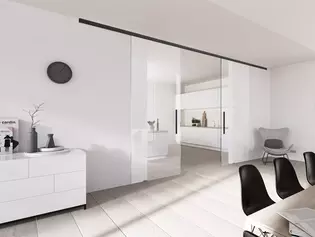
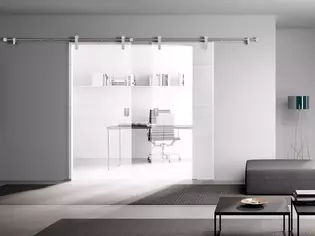
Sliding door track as visible fitting
Sliding door is simply a door leaf or several door leaves, which instead of swinging in a frame, hang on a Running track. Along the Length of this rail, they can be moved sideways. This system may or may not have a second rail on the Floor. The top Running track holds the weight of the door, while the bottom track keeps the door from swinging back and forth. The top Running track can be mounted on the wall or ceiling.
The door slides in front of the wall when opened, exposing the Door frame. Both the door and the running track and door hardware are always visible in this variant. They form an important design element in the room.
The Running track can be closed or open. With a closed Running track, the Transport trolley is inside the track, and only the track itself is visible.
With an open fitting, you can clearly see the Transport trolley running on a tube. The door leaf is fixed with glass clamps or screwed to the Rolls with connectors.
Selection Griffwerk Sliding door running tracks


Invisible sliding door track
An invisible Running track combines design with function: the door disappears IN the wall when opened. This variant of the Sliding door is suitable for small apartments or offices, where the wall space is needed for shelves or other furniture. This variant is also interesting for customers who do not want to put the design accents on the door: if the door disappears into the wall when needed, there remains space for pictures, wall hangings or wall tattoos.
The door can disappear with an invisible Running track in the cavity between two-shell drywall. But there are also modern wall pocket systems designed specifically for Sliding doors that disappear into the wall. Anyone who is renovating an apartment and designing it from scratch or tackling a new build can add such a system very easily.
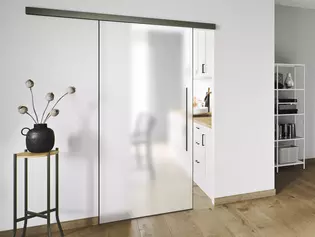
Simple sliding door tracks as a design element
GRIFFWERK Glass sliding doors are available either with a surrounding frame or hanging on simple rails. The simple running track running visibly in front of the wall takes on a different characteristic depending on the material and color scheme: In Graphite black, the running track of the Sliding door stands out the most, especially against a white wall. It is then used very deliberately as a minimalist but expressive design element and goes particularly well with apartments in Industrial style, Bauhaus or loft. A simple Running track in Cashmere grey achieves the same effect in a toned-down, softer form. It stands out, but does not contrast too much with the surroundings. This variant is well suited for apartments in Ethno style, Hygge, Scandinavian or even Modern Country.
Simple Running track made of frosted Stainless steel is modern and restrained. It fits well into any modern home, but draws None attention to itself. This running track is the way to go to make a Glass sliding door running in front of the wall as invisible as possible. The accents are then on light, space and other Deco elements, while the door is limited to its functionality. It is precisely in this restraint of the Running track that its charisma on the design of the entire room lies. Choose the right Bar handle or shell for each Running track.
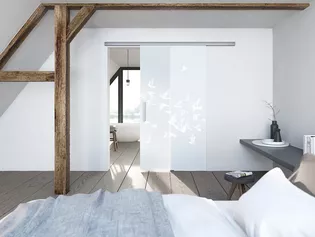
Open hardware with visible Rolls emphasizes the functionality of the Running track and can add a rustic touch to the home.
To ensure that Sliding doors open and close smoothly and quietly, we install a Soft-Close retractable mechanism on our Running tracks. The soft-close mechanism, with its damping, not only ensures quietness and the best functionality, but also ensures that the Sliding door stays intact longer.
The most frequently asked questions about Sliding door running tracks
What questions are most often asked about Running tracks? We found out using software that analyzes the questions people ask voice assistants from Apple, Google and others. We answer three of them here:
1. what are the Running track types?
Basically visible rails in front of the wall (closed profile or open rollers) and invisible systems in the wall (wall pocket). Visible rails make a design statement, invisible solutions have a maximum purist effect.
2. wall or ceiling mounting: which is better?
Wall mounting is often easy to retrofit (ideal for renovations). Ceiling mounting has a more planar effect and uses the full passage height - good for high rooms or if the technology should appear as quiet as possible.
3. do I need a floor guide?
Yes, a floor guide generally keeps the door leaf stable so that it does not swing. This noticeably improves operation, especially with wide or double-leaf doors.
4 What are the benefits of soft close?
The soft-close mechanism brakes the door at the end of the run and closes it quietly. This protects fittings and glass and prevents banging - a convenience plus in everyday life.
5 Which surface suits my style?
Graphite black creates clear contrasts (industrial/loft), cashmere gray has a softer effect (scandi/hygge), matt stainless steel is timeless and understated - ideal if the door is to remain visually in the background.