
Sliding door systems: quiet, space-saving, plannable
Griffwerk sliding door systems combine precision mechanics with sophisticated design—and can be configured as a complete system or as individual components: Running track, door leaf, handle, and seal—all from a single source, perfectly coordinated in finish, function, and dimensions. Whether you’re replacing a single interior door, flexibly dividing an open floor plan, or closing an opening in a wall to optimize space—you’ll find the right system here.
Select installation type (wall or ceiling), alignment (in front of the wall or flush with the wall), comfort features (soft-close, “silent”), and finish—from Graphite black to Cashmere grey to stainless steel. You can combine matching glass door leaves and Handles right here.

Every sliding door saves space and gives every home a modern atmosphere. A sliding door is versatile, flexible and also makes your home more flexible: whether as a patio door, a practical room divider or a functional solution for niches and cupboards. But why are they often called "sliding door systems"? Because they can be combined from individual parts that can be individually matched to each other like hardly any other type of door.
GRIFFWERK sliding door systems combine precision mechanics with sophisticated design—and can be configured as a complete system or as individual components: running track, door leaf, handle, and seal—all from a single source, perfectly coordinated in finish, function, and dimensions. Whether you’re replacing a single interior door, flexibly dividing an open floor plan, or closing an opening in a wall to optimize space—you’ll find the right system here.
All GRIFFWERK sliding door systems come standard with a soft-close mechanism: The door is gently slowed at the end of its travel and closes silently. For maximum quiet operation, the Silent System is available with vibration-minimized rollers and guide elements. If you’re looking for a tightly sealing sliding door, PLANEO AIR offers a solution that reliably reduces noise, drafts, and odors—without sacrificing the minimalist aesthetic of a Glass sliding door. Our sliding door experts will be happy to assist you in making your selection.
What does a "sliding door system" consist of?
The most important component of any sliding door is, of course, the door leaf. It closes the doorway and gives the room character with its design: modern or traditional, unobtrusive or eye-catching. Door leaves for sliding doors can be made of wood or glass. Less frequently, and then mainly in industrial buildings, they are made of metal. Material combinations are also possible, for example metal frames or pilaster strips for a beautiful loft look or industrial style.
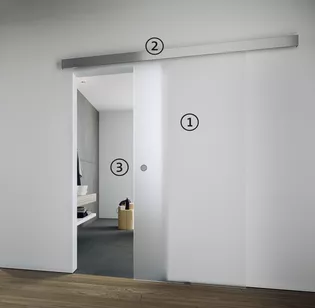
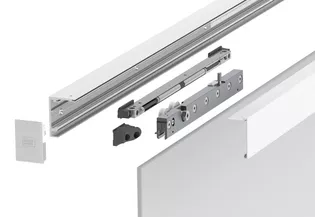
The door leaf usually hangs on rollers or trolleys . They are usually made of metal and allow the door to slide smoothly. The rollers in turn are attached to the rails along which the door can be moved. The rails are mounted at the top of the wall if the door runs in front of the wall, or in a space between the walls if the door is pushed into the wall. The door often simply hangs on the rails and has no contact with the floor. However, if you want a tightly closing sliding door through which neither noise nor odors can escape, you must also install a track on the floor. Even if the door is not intended to close tightly, an additional floor track gives the door leaf more stability and security.
Our "Silent" sliding door system uses special rollers and guide elements that minimize vibrations and thus ensure that the door glides very quietly.
To move the door leaf along the tracks, a sliding door has special handles instead of classic door handles: handle bars or handle shells. Both are important design elements, as their shape can give the room a soft or linear character. Their color determines whether, for example, a sliding glass door leaves the main role to other elements such as furniture or walls, or whether the door should be an eye-catcher. Handle bars are easier to operate than the rather small handle shells and are therefore more suitable for homes where children or senior citizens live.
Sliding door handles always include the locking mechanisms. These can be locked manually or automatically. A particularly modern automatic locking mechanism is our Smart2Lock system. It uses sensors to detect whether the door is closed correctly before it is locked.

Many Sliding doors have seals to protect against draughts, dust, noise and odors. The PLANEO AIR SILENT system, for example, closes seamlessly against the wall with rubber lips on the sides. It thus combines the advantages of Sliding doors with those of Hinged doors. The special feature: an elegant aluminum frame in Cashmere grey, Graphite black or stainless steel look hides the sealing system and makes it almost invisible.
Whether you need a complete Sliding door system or just one component, or if you have any questions about Purchasing and installation, our sliding door experts will be happy to advise you.
5 Steps to Finding the Right Sliding Door System
- Installation:In front of the wall (visible track, easy to retrofit) or inside the wall (ultra-minimalist, wall pocket required).
- Installation:Wall = quick to retrofit; ceiling = full headroom & very sleek appearance.
- Convenience:Soft-close mechanism for gentle closing; silent components minimize vibrations for exceptionally quiet operation.
- Guides & Seals:Bottom guide prevents swaying; tightly sealing solutions (e.g., with side sealing lips) reduce drafts, odors, and noise.
- Appearance: Finish (Graphite black, Cashmere grey, stainless steel look); choose a matching Bar handle or Inset handle.
Sliding door systems: Fittings, carriages, guides


Sliding door systems: Glass door leaves


Sliding door systems: Sliding door handles


5 steps to the right sliding door system
- Installation:In front of the wall (visible rail, easy to retrofit) or in the wall (maximum purist; wall pocket required).
- Installation:Wall = quick & easy to retrofit. Ceiling = full passage height, very quiet image.
- Comfort:Soft close brakes and closes quietly; silent elements minimize vibrations.
- Guidance & tightness:Floor guide to prevent swinging; side sealing profiles reduce draughts/odors/sound.
- Look & operation:Handle bar (comfort) or recessed handle (flush); surface to match the furnishings.
Tip: Finally, a practical added-value paragraph for sliding door systems - without overlapping with existing page content:
Before you order, simulate everyday life: tape off the planned walkway with painter's tape (incl. door width) and check for a few days whether skirting boards, light switches, thermostats, coat hooks, door stoppers, furniture edges or window handles collide. Think about floor transitions (joint/rail/carpet edge) and the vacuum robot - a flat, easily accessible floor guide makes maintenance easier. Take photos of the wall in the construction phase/as-built, mark concealed cables (electricity/heating) and make a note of the substrate (plasterboard, brickwork, concrete) for suitable wall plugs. Take ergonomics into account: Select the handle height so that children/elderly people can operate it comfortably; for multi-family households, a handle bar on the inside, a recessed grip on the outside can defuse passageways. For quietness and tightness, ensure continuous wall support without light switches in the sealing area; small felt/brush inserts at contact points prevent rattling. After installation: check all screw connections after 4-6 weeks, fine-tune the roller carriage, test the soft close, then carry out an annual check (remove dust from the track, use silicone/PTFE-suitable lubricant spray sparingly). Create a documentation folder (dimensions, surfaces, spare part numbers) - this saves time when reordering, converting or reselling the property at a later date.