
All about handle sets
What sounds strange at first, we all know: We open and close doors every day with lever handle sets, door handle sets or door fittings. Which types there are, which parts they consist of and how you install them - it's all here.
What are handle sets?
What we usually call a "door handle" in everyday life is just one part of the lever handle set and is actually called a "lever handle" or door handle: By operating it, we can open and close a door. Inside the door there is a square lever handle pin, which is connected to one lever handle on each side - via the so-called spindle part. If one of these door handles is pressed down, the square handle pin rotates and moves the bolt of the door lock: the door can be opened.
The different parts of the handle set
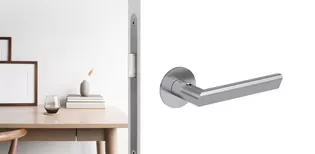
First of all, according to the shape distinguish the shield and rosette sets.
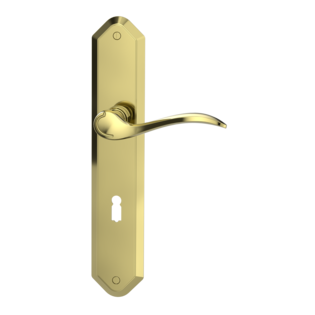
In a escutcheon set, the door handle - latch or knob - is visually connected to the keyhole, and the escutcheon covers the space between the two. There are long backplate and short backplate sets. Both work the same way, so the choice is a matter of taste.
In a escutcheon set, the door handle - latch or knob - is visually connected to the keyhole, and the escutcheon covers the space between the two. There are long backplate and short backplate sets. Both work the same way, so the choice is a matter of taste.
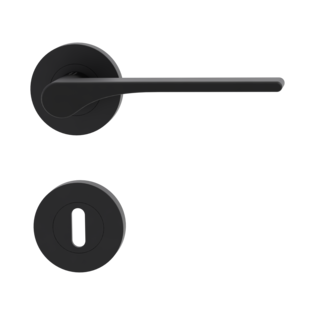
Furthermore, a distinction is made according to the function. Apart from the classic form of the handle set with a lever handle on each side of the door, there are also interchangeable and half sets.
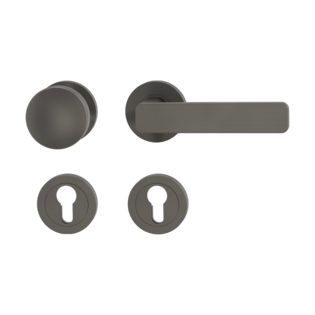
In the case of an interchangeable set, there is a lever handle on the inside of the door and an immovable handle on the outside. This means that the door can only be opened from the inside without a key. Therefore, interchangeable sets are mainly used for house or apartment doors.
A half set is - as the name suggests - a half handle set. With it, you can create a coherent design of the rooms in your apartment: If you want one room to have a different ambiance than the adjacent hallway, simply choose different half sets for each side of the door. For example, you can go from a modern hallway to a cozy living room - with matching lever handles.
Installation of a handle set
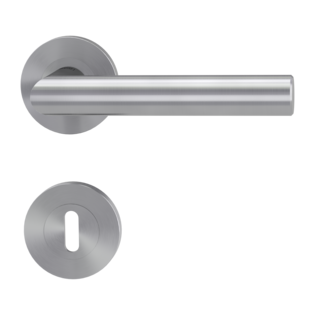
From the structure of a handle set, it follows how it must be mounted: If the door has a lock and keyhole, insert the square lever handle pin into one of the two lever handles (pin part) and push it through the lock. From the opposite side, press the other lever handle against it (hole part). Once both lever handles have been fixed in the door in this way, plates or rosettes can be attached.
What material are handle sets made of?
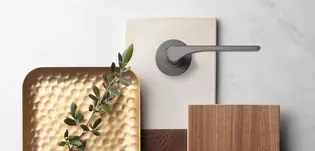
Whether iron, bronze, brass, chrome, aluminum or stainless steel, brushed or smoothly polished, in antique look or cheap and colorful plastic - handle sets are available in many materials. However, plastic sets are somewhat less durable.
What should I look for when buying?
Of course, you should like your new lever handle set first and foremost. In addition to aesthetics, other factors play a role in the purchasing decision: durability, fire resistance, personal safety, burglar resistance and corrosion resistance all play a role - depending on where the lever handle set is used. These properties are categorized in the "DIN EN 1906" standard. In general, the higher the class number in a category, the better the performance of the handle set. For example, a handle set in corrosion resistance class 1 is only slightly resistant to corrosion and one in class 5 is extremely resistant to corrosion. The lowest class is generally sufficient for normal room doors. However, if you wish to purchase lever handle sets for buildings with a risk of fire, burglary, corrosion or heavy public traffic, you should look for correspondingly higher class numbers in accordance with DIN EN 1906.
We use lever handle sets many times a day. This is why they can wear out over the years and the lever handles can sag slightly due to gravity. To prevent this, special hold-up springs are installed - also known as return springs. Thanks to them, the lever handles always spring back up again. So when buying, make sure that a hold-open spring is installed.
One aspect that deserves particular attention when considering lever handle sets is the ergonomics and feel of the door handles. As door handles are used many times a day, comfort when gripping them plays a decisive role. Innovative designs, such as the TRI 134 model from Griffwerk, take into account the natural shape of the hand and offer a particularly pleasant grip thanks to a three-sided handle profile. Such ergonomically designed handles adapt to the shape of the hand and enable intuitive operation, which not only increases comfort but also improves user-friendliness. In addition, high-quality materials and surface finishes, such as Griffwerk's soft2touch technology, contribute to a pleasant feel and give the door handle a velvety surface that is both visually and tactilely appealing. When selecting a handle set, it is therefore important to consider not only the design and material, but also the ergonomic aspects and feel to ensure a harmonious combination of functionality and aesthetics.
In 2 steps: Disinfect the handle set
- First remove visible dirt. Use a damp cloth and a little all-purpose cleaner.
- Wet the handle set completely with disinfectant. Allow it to dry.
The most frequently asked questions about the handle set
Which questions are most frequently asked about lever handle sets? We found out using software that analyses which questions people ask voice assistants from Apple, Google and others. We answer three of them here:
What type of handle set is available?
There are very different ones, all of which Griffwerk has in its range: Rosette sets, shield sets, interchangeable sets, half sets and renovation plates. All handle sets are available in a wide variety of shapes and materials - whether stainless steel, aluminium or brass.
Is every handle set standardised?
Yes - according to DIN standard 107. A distinction is made according to the stop direction: DIN left and DIN right.
What does "BB" stand for in a lever handle set?
This stands for Buntbart set. The buntbart key is the typical key shape for interior flat doors.
Standards, material combinations and maintenance for lever handle sets
In addition to the designs and materials already mentioned, lever handle sets are also assessed according to the application and long-term function categories of DIN EN 1906 (including frequency of use, load-bearing capacity, corrosion resistance, safety). A medium category is usually sufficient for private living areas, while highly frequented zones (stairwells, buildings) benefit from higher categories with a proven service life. The following also applies to fire and smoke protection doors: The approval of the overall system is decisive (e.g. in accordance with DIN 18273); the fittings, fastening and substructure are tested as a unit. For this reason, no individual parts(lever handles, rosettes, screws) may be exchanged "crosswise" - otherwise the system approval will expire. Continuous screw fittings with pressure distributors are often prescribed for installation; the specified tightening torques must be adhered to in order to avoid deformation of the lock case.
With material and surface combinations, the pairing determines durability and appearance. Avoid contact corrosion: Different metals (e.g. aluminum ↔ stainless steel) should be decoupled; stainless steel (e.g. 1.4301/1.4404) is a robust basis, PVD-coated surfaces increase scratch and abrasion resistance in heavily used areas. In coastal and wellness environments, stainless steel with increased corrosion resistance is worthwhile; in medical/public areas, disinfectant-resistant surfaces make sense. Also pay attention to the feel and ergonomics of the handle (softly rounded edges, sufficient recess to the door surface) so that the fitting lies securely even with wet hands. If existing drilling patterns are to be concealed, long escutcheons offer a calm, concealing appearance; rosettes have a more purist look, but require a precisely fitting drilling pattern.
To maintain operational value, we recommend a short, predictable maintenance routine: after 4-6 weeks (setting phase), retighten all screw connections crosswise and check the return of the lever handle; then check annually(substructure, hold-up springs, play on the square). Clean surfaces with a damp cloth using a mild, pH-neutral cleaner and then dry; avoid abrasive, chlorinated or acidic agents and aggressive glass cleaners. In the case of contract furniture, if necessary, store a cleaning and disinfection plan (observe the manufacturer's compatibility list). In highly frequented areas, magnetic latches/band buffersreduce the closing noise and protect the fittings and frame. Document serial/article numbers, surface designations and installation instructions centrally - this speeds up spare parts orders (rosettes, screws, substructure) and keeps the approval chain traceable in the event of servicing.
Selection Griffwerk lever handle sets


How to choose the right lever handle set
- Door & use: room door, apartment entrance, property? → Clarify requirements for permanent function/protection.
- Design:Rosette or escutcheon; BB/PZ/WC or change/half depending on lock/cylinder.
- Standards: Pay attention to DIN EN 1906 (usage categories, corrosion, etc.) and any other protection/fire protection standards for the intended use.
- Technology:Hold-up spring (return spring) to prevent "hanging down", precise bearing for smooth operation.
- Material & finish: Stainless steel/chrome/aluminum, black, grey, brass look - select to match the doors/profiles in the building.
How to recognize good lever handle sets
- Hold-up springs: Pushers are perfectly horizontal - no "sagging".
- Precise bearing/substructure: backlash-free fit, smooth return, durable.
- Ergonomics (e.g. three-sided handle profile) & soft2touch surfaces: better feel, less "cold".